Magnetic Testing
DXV-250 VSM with Temperature Control
Vibrating Sample Magnetometer (VSM)
VSM with integrated temperature control for studying magnetisation behaviour from low to elevated temperatures.
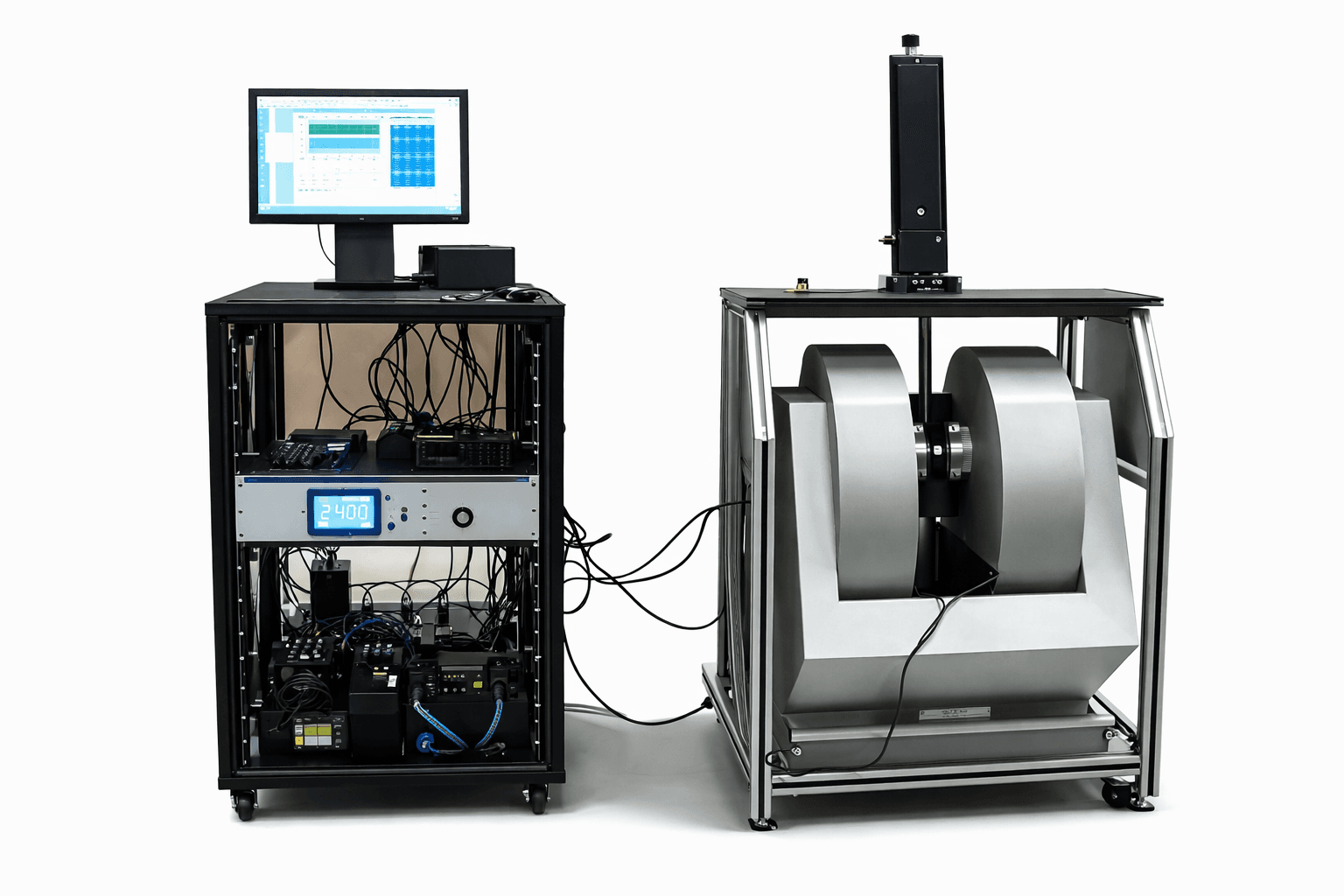
Product Overview
DXV-250 Vibrating Sample Magnetometer (VSM) with Temperature Control is designed for advanced magnetic materials research, quality control and product testing. The system enables precise measurement of magnetic properties such as magnetization curves, hysteresis loops and demagnetization curves.
The instrument can determine magnetic parameters including saturation magnetization, residual magnetization, coercive force, magnetic energy product and magnetic permeability. With integrated high and low temperature options, the system allows in-situ magnetic measurements over a wide temperature range.
It supports measurement of powders, granules, thin flakes and bulk magnetic materials.
Key Features
- Accurate measurement of magnetic properties of materials
- High sensitivity magnetic moment detection
- Magnetic field strength up to 2.2 Tesla
- Temperature-dependent magnetic measurements
- Compatible with powder, pellet and bulk samples
- Computer-controlled measurement and analysis system
Temperature Measurement Capability
The DXV-250 VSM supports magnetic measurements across a wide temperature range.
- Room temperature to 500°C using high-temperature furnace
- Room temperature to liquid nitrogen temperature using low-temperature system
- Temperature resolution of 0.1 K
This allows researchers to study temperature-dependent magnetic behaviour including Curie temperature and magnetic phase transitions.
Main Specifications
| Parameter | Specification |
|---|---|
| Magnetic Moment Range | 10⁻³ emu – 300 emu |
| Sensitivity | 5 × 10⁻⁵ emu |
| Relative Accuracy | Better than ±1% |
| Repeatability | Better than ±1% |
| Stability | Better than ±1% after 4 hours operation |
| Magnetic Pole Gap | 35–40 mm |
| Pole Diameter | 60 mm |
| Maximum Magnetic Field | 2.2 Tesla |
| Temperature Range | Room temperature to 500°C / Liquid nitrogen |
System Components
| Component | Description |
|---|---|
| Electromagnet | DXSG-250 water-cooled electromagnet |
| Magnetic Measurement Unit | Includes scanning power supply, lock-in amplifier, Tesla meter |
| Vibration System | Vibrating head, vibrating rod and detection coil |
| Control Computer | Lenovo industrial control computer |
| Printer | HP printer |
| High Temperature System | Furnace for measurements up to 500°C |
| Low Temperature System | Liquid nitrogen cooling system |
Optional components:
- Vacuum pump
- Liquid nitrogen tank
- Water circulation cooling system
- Electromagnet water chiller
Instrument Description
Electromagnet
The electromagnet is a double-yoke fixed air-gap electromagnet positioned at 45°. The magnetic field is horizontal with a pole diameter of 60 mm and maximum magnetic field strength of 2.2 Tesla. The electromagnet uses a water-cooling system for stable operation.
Power Supply
The system uses a high-stability DC regulated power supply rated at approximately 10 kW. The output current can be continuously adjusted and includes protection features such as phase-loss protection, over-current protection and automatic short-circuit protection.
Vibration System
The vibration system includes a vibrating rod, mechanical vibrating head, bracket, sample chamber and detection coil used to generate the magnetic signal during measurement.
Magnetic Measurement Unit
The measurement system provides multiple magnetic moment ranges from 300 emu down to 0.015 emu with sensitivity better than 5 × 10⁻⁵ emu.
Magnetic field measurement resolution is 0.1 mT with accuracy better than ±1%.
The vibration source operates at 180 Hz with high frequency stability.
Measurement Software
The VSM250 measurement software provides an intuitive interface for configuring measurement parameters and analysing data.
Features include:
- Automatic measurement of magnetisation curves and hysteresis loops
- Fast MH loop measurement and background correction
- Heating and cooling curve analysis
- Temperature-dependent magnetic measurements
- Data export and processing using Excel and Origin
- Automatic calculation of magnetic parameters including saturation magnetisation, coercive force and Curie temperature
Applications
- Magnetic materials research and development
- Temperature-dependent magnetism studies
- Magnetic nanoparticles and advanced materials analysis
- Industrial magnetic materials testing
- Academic and research laboratories
Related Products
Explore adjacent systems and categories that are commonly evaluated together in hard magnetic testing workflows.