Magnetic Testing
Magneto-optic Kerr Effect Systems
Magneto-optic Kerr effect (MOKE) instruments for imaging magnetic domains, measuring Kerr hysteresis loops and characterising thin films, wafers and spintronic devices.
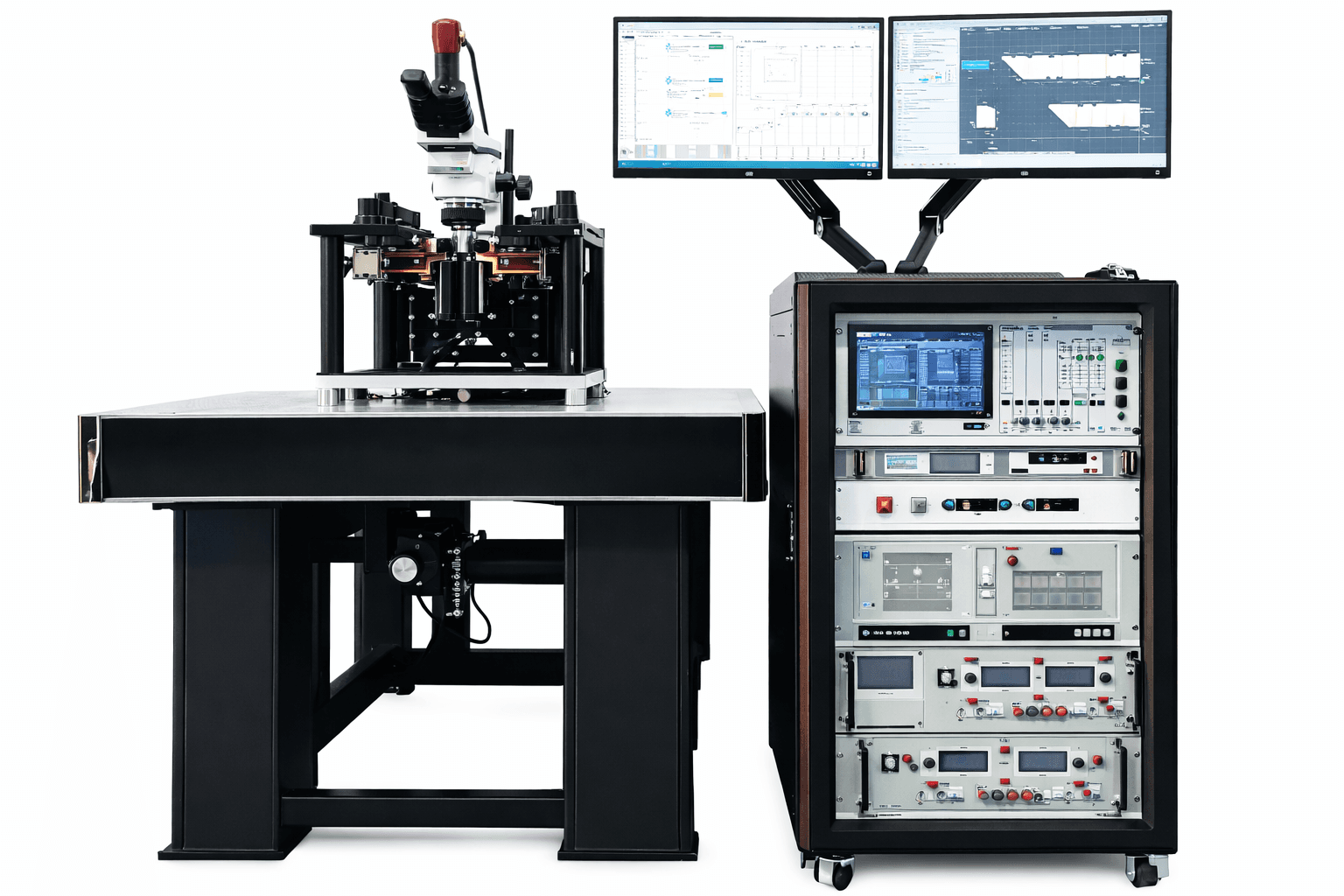
Multifunctional Magneto-optical Kerr Microscopic Imaging System
Magneto-optical Kerr microscopic imaging system for visualising spatial distribution and time evolution of magnetisation states in magnetic materials and spintronic devices.
View Details →
Surface Magneto-optic Kerr Effect System
DXMOKE series surface MOKE system for measuring longitudinal, transverse and polar Kerr rotation angles and hysteresis loops to analyse coercivity and saturation fields.
View Details →
Wafer-Level Magneto-Optic Kerr Measuring Instrument
Wafer-level MOKE measuring instrument for fast, non-contact global magnetic property testing of wafer stacks without damaging delicate samples.
View Details →
Micro MOKE Magnetic Measuring Instrument
Micro MOKE magnetic measuring instrument using magneto-optical Kerr effect to measure magnetic hysteresis loops with high speed and precision without contacting the sample.
View Details →
Scientific Research Grade MOKE Hysteresis Loop Tester
Scientific-grade MOKE system for hysteresis loop measurement of magnetic materials, supporting both in-plane and out-of-plane magnetic field configurations.
View Details →MOKE Measurement Principles
The magneto-optic Kerr effect (MOKE) is a change in the polarization state of light when it reflects off the surface of a magnetized material. MOKE systems use this effect as a non-contact optical technique to image magnetic domains and measure Kerr hysteresis loops without physically contacting or damaging the sample.
Because MOKE is surface-sensitive and non-contact, it is particularly well suited to thin films, wafers and spintronic devices, where a VSM's bulk sample measurement or a Hall Effect system's contact-based electrical measurement may be less practical.
For characterizing a material's bulk magnetic moment instead of its surface, see MAGTRANS' Vibrating Sample Magnetometer (VSM) systems. For measuring electrical transport properties such as carrier concentration and mobility, see MAGTRANS' Hall Effect Measurement Systems.
Frequently Asked Questions
What is MOKE (magneto-optic Kerr effect)?
The magneto-optic Kerr effect (MOKE) is a change in the polarization of light when it reflects off a magnetized material surface. MOKE systems use this effect as a non-contact optical technique to image magnetic domains and measure Kerr hysteresis loops.
How is MOKE different from a Vibrating Sample Magnetometer (VSM)?
A VSM measures the bulk magnetic moment of an entire sample by physically vibrating it in a magnetic field, while MOKE is a non-contact optical technique that is especially well suited to thin films, wafers and surface-level magnetic domains.
What materials and devices are MOKE systems used to characterize?
MOKE systems are used to characterize thin films, wafers and spintronic devices, including imaging magnetic domain structure and measuring Kerr hysteresis loops at the surface or wafer level.