Intelligent Thermal Cooling Solutions
Liquid, industrial and air cooling; value-added solutions; cooling towers, air dryers, dehumidifiers and humidifiers for process stability and climate control.
Trusted Across
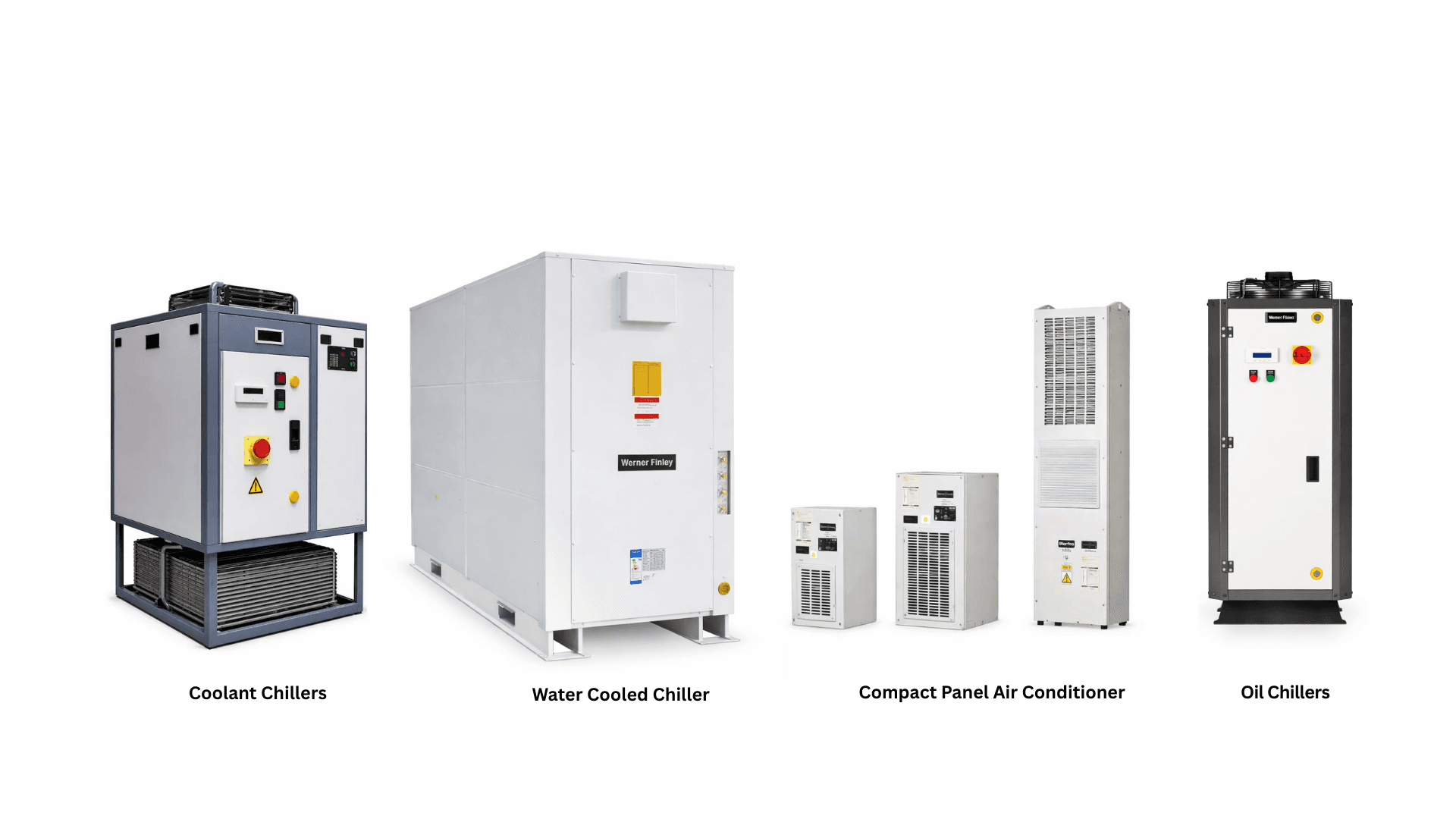
Liquid Cooling Solutions
High-performance air and water-cooled chillers, coolant chillers, and modular systems for demanding processes.
Air Cooling Solutions
Panel air conditioners and precision data center cooling systems where ambient air is the primary heat sink.
Value Added Cooling Solutions
Engineered utility packages, dehumidifiers, and environmental control systems tailored for your facility.
Industrial Process Cooling Fundamentals
Process cooling is the engineered extraction of heat from industrial, manufacturing, or laboratory processes. Unlike HVAC systems designed for human comfort, process cooling systems—such as industrial chillers—are designed to operate 24/7 under fluctuating loads while maintaining stringent temperature stability.
Vapor Compression Cycle
Most active chillers operate on the vapor compression refrigeration cycle. A refrigerant absorbs heat from the process fluid (like water or oil) in the evaporator. The compressor pressurizes the refrigerant gas, raising its temperature, before pushing it into the condenser. Here, the heat is rejected into the ambient air (air-cooled) or a secondary water loop (water-cooled), converting the refrigerant back to a liquid to repeat the cycle.
Crucial Selection Criteria
- Cooling Capacity: Measured in kW or Tons. The system must overcome the total heat load generated by the equipment.
- Temperature Stability: Many scientific applications require ±0.1°C stability to prevent thermal expansion of sensitive components.
- Flow Rate & Pressure: The internal pump must provide sufficient GPM (Gallons Per Minute) to overcome pressure drops in the external process loop.
Frequently Asked Questions
What is Process Cooling?
Process cooling refers to the continuous removal of excess heat generated during industrial or laboratory operations. It ensures that sensitive equipment—like laser cutters, microscopes, or data centers—operates within precise temperature tolerances, preventing overheating and improving product quality.
How do I choose between an Air-Cooled and Water-Cooled chiller?
Air-cooled chillers dissipate heat into the ambient air using fans, making them easier to install as they don't require a cooling tower. Water-cooled chillers use a secondary water loop (often connected to a cooling tower) to remove heat; they are typically more energy-efficient and suitable for large-scale or high-ambient-temperature environments.
Why is temperature stability important?
Many high-precision instruments and manufacturing processes require strict thermal control. A temperature fluctuation of even 0.1°C can cause thermal expansion in materials, altering measurement precision or causing defects in semiconductor manufacturing.