Functional Material Measurement
Dielectric Measurement System
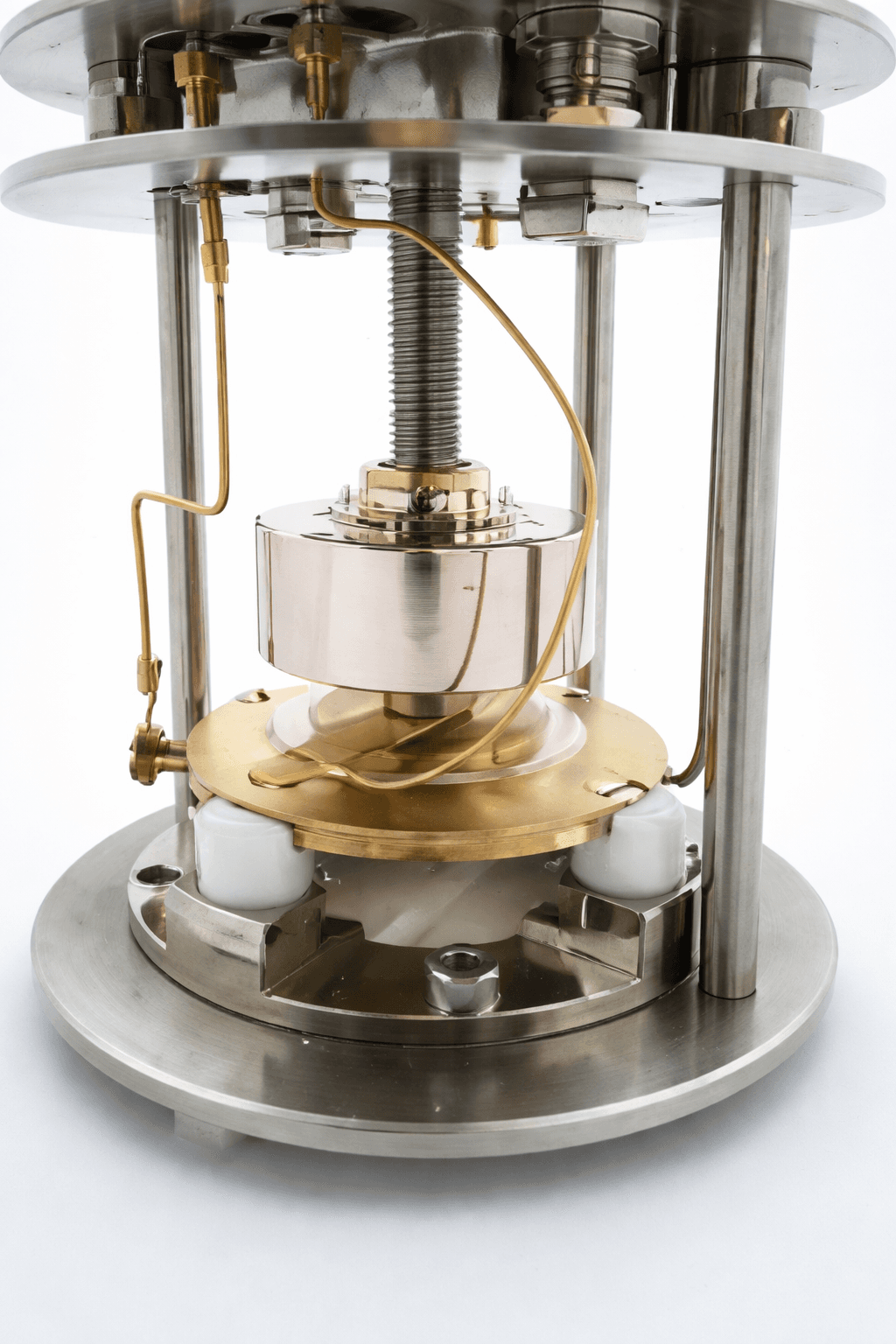
The high and low temperature dielectric temperature spectrum measurement system is mainly used for electrical testing of insulating materials at different temperatures and frequencies, with extended capabilities for breakdown testing and thermally stimulated depolarization current (TSDC) measurements.
The system supports continuous and high-speed measurements under different measurement conditions and measurement modes, providing a flexible platform for characterising dielectric behaviour across a wide operating range.
Measurement Parameters
| Temperature range | -185 ~ 600°C |
| Sample size | φ < 25 mm, d < 4 mm |
| Temperature control accuracy | ±0.25°C |
| Electrode material | Platinum |
| Temperature rising slope | 10°C/min (adjustable) |
| Clamp auxiliary material | Aluminum nitride ceramic |
| Test frequency | 20 Hz ~ 10 MHz |
| Low temperature refrigeration | Liquid nitrogen |
| Heating method | DC electrode heating |
| Test function | Dielectric temperature spectrum, frequency spectrum |
| Cooling method | Water cooling |
| Data transmission | RS-232 |
| Input voltage | 110 ~ 220 V |
| Equipment size | 180 mm × 210 mm × 50 mm |
Eliminate the impact of grid harmonics on collection accuracy
Power grid harmonics are high-order harmonic components that exist in electrical power systems in addition to the fundamental voltage and current. These harmonics are generated by nonlinear loads where the relationship between current and voltage is nonlinear, resulting in non-sinusoidal current waveforms and harmonic generation.
Harmonics can seriously interfere with electrical equipment such as communication systems, computer systems, processing machinery and testing instruments. Most heating systems use AC heating wires powered by a 50 Hz sine wave, which can introduce additional noise into sensitive measurements.
To reduce interference caused by power frequency and harmonics, Dexinmag instruments use DC heating technology. Additional filtering techniques are also applied to further reduce harmonic influence, greatly improving measurement accuracy for dielectric characterisation.
Eliminate the influence of measurement wire impedance and internal shielding in high-temperature environments
Transmission lines are affected by their materials and structural properties. When transmitting high-frequency signals, the ratio between voltage and current along the conductor can change, and impedance mismatches may introduce measurement errors. Impedance-matched measurement cables are therefore required during the measurement process.
Measurement cables themselves also have impedance and high-frequency response characteristics, so shortening the measurement wires improves accuracy. In high-temperature environments, measurement wires cannot be fully shielded and are usually only insulated. Due to temperature changes, the resistance of high-temperature wires increases, and passage through ceramics or refractory materials introduces additional capacitance into the measurement path.
To minimise these effects, the system adopts a three-electrode measurement method that provides better shielding performance and reduces the influence of lead impedance and stray capacitance on the measured dielectric properties.
Optimize sample temperature measurement methods and measurement electrodes
Based on the parallel-plate electrode measurement principle, the electrode used for measurement should be as small as possible to reduce stray capacitance and the influence of surrounding space. A conductive layer is sputtered onto the sample surface to create a precise, well-defined electrode geometry.
Since different materials have different thermal expansion coefficients, temperature measured by a thermocouple placed near the sample may differ slightly from the actual sample temperature. Using a reference sample during measurement allows more accurate determination of the true sample temperature and improves correlation between thermal and dielectric data.
Operational Software
The test system software platform is developed using the LabVIEW system. It meets various testing requirements for functional materials and provides high stability and operational safety, including power-off data protection so that test data and images can be saved and restored after unexpected interruptions.
The software is compatible with Windows XP, Windows 7 and Windows 10. Key features include a multilingual interface (Chinese / English), real-time monitoring of system testing status, legend management using status icons, user permission management, fault alarm functions and customizable test report generation with export to Excel and PDF formats.
Software Compatibility
The dielectric measurement system is compatible with multiple impedance analysis instruments, enabling flexible hardware configurations and protection of existing investments:
Keysight
- E4990
- E4991
- E4980A
Wayne Kerr
- 6500B
- 6530
- 4235
Tonghui
- 2983
- 2838
- 2851